Top Benefits of In-Home Music Lessons for Kids in San Antonio
San Antonio, Texas, is a city with a soul deeply rooted in music and cultural expression. From the vibrant mariachi performances echoing along the River Walk to the classical symphonies playing at the Tobin Center for the Performing Arts, music is woven into the very fabric of our community. As parents, we naturally want to share this rich musical heritage with our children. However, in today’s fast-paced world, finding the time to nurture a child’s artistic talents can be a logistical challenge. This is where the magic of in-home music lessons comes into play. If you are considering enrolling your child in piano, voice, or speech lessons, bringing the instructor to your living room might just be the best decision you can make. In this comprehensive guide, we will explore the top benefits of in-home music lessons for kids in San Antonio, diving deep into cognitive development, emotional well-being, and the unmatched convenience that programs like Cruz Music Studio provide.
Why Choose In-Home Music Lessons in San Antonio?
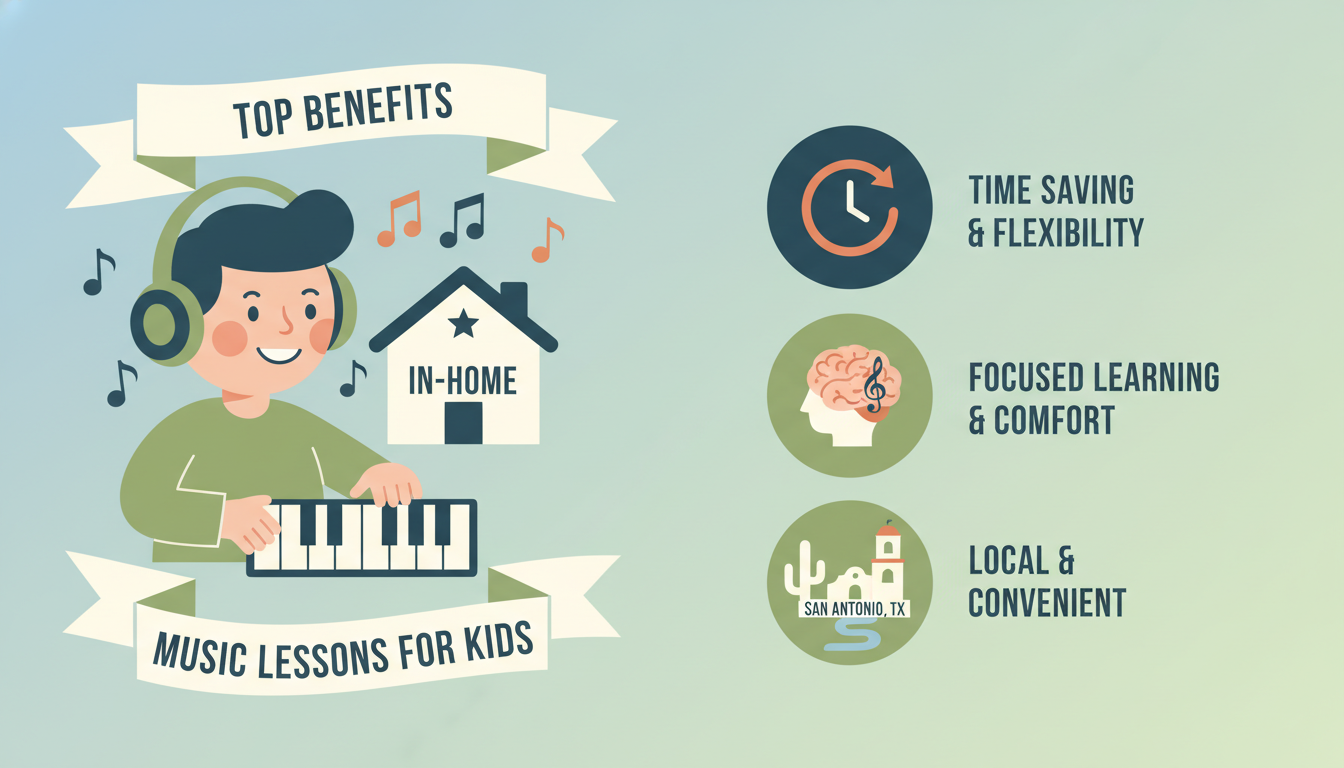
Let us face the reality of living in a sprawling, dynamic city like San Antonio: traffic can be unpredictable. Between navigating Loop 1604 during rush hour, enduring the construction on I-10, and managing a household schedule packed with school drop-offs, sports practices, and family commitments, simply getting to a 30-minute music lesson can consume hours of your week. In-home music lessons completely eliminate the commute. Instead of rushing across town, parents can relax, prepare dinner, or catch up on work while their child receives elite, one-on-one musical instruction in the safety and comfort of their own home. Beyond convenience, the home environment plays a critical role in learning. Traditional music studios, while effective for some, can be intimidating for young beginners or children who are naturally shy. The pressure of playing in front of peers, the sterile environment of a practice room, and the distracting sounds of other instruments bleeding through the walls can hinder a child’s focus. By learning at home, children play on their own piano, sing in a space where they feel completely secure, and associate their home with a sanctuary of creativity and growth.
5 Transformative Benefits of Private In-Home Music Education
1. Accelerated Cognitive Growth and Academic Performance
The link between music education and cognitive development is one of the most thoroughly researched topics in child psychology. When a child learns to read sheet music, understand rhythm, and translate those symbols into physical movements on a piano or vocal techniques, they are engaging multiple areas of their brain simultaneously. It is akin to a full-body workout for the mind. According to a comprehensive study commissioned by the University of Georgia and Guitar Center, children who participate in private music lessons exhibit significantly enhanced problem-solving skills, better time management, and a stronger ability to prioritize tasks [1]. The discipline required to master an instrument translates directly to improved academic performance. The patterns and fractions inherent in music theory naturally boost mathematical comprehension, while learning to interpret musical phrasing enhances literacy and reading comprehension. In an in-home setting, a highly trained instructor can tailor these cognitive challenges to the child’s exact developmental stage, ensuring they are consistently stimulated without becoming overwhelmed.
2. Enhanced Emotional Intelligence and Self-Expression
Music is fundamentally a language of emotion. For children, particularly those who may struggle to articulate their feelings through words, music provides a safe and powerful outlet for self-expression. Research highlighted by the University of Queensland demonstrates that early, informal music-making at home leads to superior cognitive and social-emotional outcomes by the time a child reaches school age [2]. Through voice lessons or piano instruction, children learn to interpret the emotional weight of a piece of music. They discover how a major chord can sound triumphant, while a minor chord conveys melancholy. Under the guidance of an expert like Abraham Isai Cruz Ramirez at Cruz Music Studio, students are taught that music is a versatile tool to polish, shape, and connect with their emotional body. Whether they are belting out a pop anthem or delicately playing a classical sonata, they are developing emotional intelligence that will serve them throughout their lives.
3. Unmatched Personalized Attention
In a group class or a crowded music school, an instructor must divide their attention among several students, often teaching to the middle and moving at a generalized pace. Private in-home lessons turn this paradigm upside down. The curriculum is built entirely around the individual student. If a child grasps a concept quickly, the instructor can immediately move to more advanced material. If they struggle with a particular vocal run or piano chord transition, the teacher has the bandwidth to pause, break the technique down, and offer the patience and grace necessary to overcome the hurdle. At Cruz Music Studio, this personalized approach is foundational. Instructors who understand vocal pedagogy, anatomy, and proper technique can custom-build a repertoire that suits the child’s unique voice and musical interests, ensuring that every minute of the lesson is maximized for their specific growth.
4. Learning in a Familiar, Stress-Free Environment
Anxiety can be a massive barrier to learning, especially in the performing arts. For a young singer or a novice pianist, the prospect of making mistakes in an unfamiliar studio can trigger stage fright before they even reach a stage. The home environment naturally neutralizes this anxiety. When a child is surrounded by their own belongings, their family, and their pets, their nervous system is regulated. This state of calm allows the brain to absorb new information more efficiently. Furthermore, taking lessons on the exact instrument they will use to practice every day—such as their family’s living room piano—ensures consistency. They learn the specific weight of the keys and the acoustics of the room, which makes independent practice sessions far more productive and enjoyable.
5. Fostering a Lifelong Love for Music and Discipline
Ultimately, the goal of music lessons should not just be to produce a child who can robotically play a few songs, but to cultivate a lifelong passion for the arts. In-home music lessons emphasize the joy of creation. Because the scheduling is flexible and the curriculum is personalized, the friction often associated with extracurricular activities is removed. The child begins to view their music instructor not just as a teacher, but as a mentor who visits their home to share a fun, collaborative experience. This positive association instills intrinsic motivation. As they experience the tangible rewards of disciplined practice—finally nailing a difficult piano piece or hitting a high note with healthy vocal technique—they learn the value of perseverance and dedication. These are character traits that will echo into their future careers and personal lives.
Hypothetical Case Study: The Journey of a Young San Antonio Musician
To truly understand the impact of in-home music education, let us look at the hypothetical story of Mateo, an eight-year-old living in the Stone Oak neighborhood of San Antonio. Mateo had always loved singing along to the radio, but he was incredibly shy. When his parents enrolled him in a local group choir, he felt lost in the crowd and his confidence plummeted. The commute to the choir practice was also taking a toll on his family’s Thursday evenings, leaving everyone stressed and exhausted. Seeking a better solution, Mateo’s parents reached out for private, in-home voice and piano lessons. From the very first session in his living room, Mateo’s demeanor changed. His instructor, utilizing expert vocal pedagogy, explained the anatomy of the voice in a fun, accessible way. Mateo learned how to use his breath as support and discovered his chest, mix, and head voice without the fear of his peers listening in. Because the lessons happened at home, his parents could listen from the kitchen, occasionally cheering him on. Within six months, Mateo was not only sight-reading beginner piano music to accompany himself, but he also confidently performed a solo at his school’s talent show. The in-home setting provided the safety he needed to find his voice, and the elimination of the commute gave his family their Thursday evenings back. This is the transformative power of personalized music instruction.
San Antonio Market Data: Demographics & Pricing Insights
The demand for high-quality music education in San Antonio is robust and growing. Demographically, families seeking these services often reside in community-oriented, suburban neighborhoods such as Alamo Heights, Shavano Park, Stone Oak, and Boerne. These parents place a high premium on extracurricular activities that offer proven cognitive and developmental benefits. They understand that music is not just a hobby, but a foundational pillar of a well-rounded education. When it comes to pricing, the San Antonio market offers a variety of options. On average, standard private music lessons at local studios range from $30 to $80 per session. However, for premium in-home lessons—particularly those taught by highly credentialed professionals with degrees from prestigious institutions like the Boston Conservatory at Berklee or Texas State University—the investment typically ranges between $60 and $90+ per hour [3]. This pricing reflects the specialized knowledge of the instructor, the personalized curriculum development, and the ultimate luxury of having the service delivered directly to your door. For parents, this investment pays dividends not just in musical proficiency, but in the time saved and the profound developmental benefits their children receive.

Frequently Asked Questions (FAQs)
What is the best age for a child to start music lessons? While children can begin informal music exploration as toddlers, structured in-home piano or voice lessons typically yield the best results starting around ages 5 to 7. At this age, children have developed the necessary fine motor skills for piano and the attention span required for a 30- to 45-minute lesson.
Do we need to own a piano to take in-home piano lessons? Yes, having an instrument at home is essential for daily practice. However, you do not need an expensive grand piano to start. A high-quality, weighted-key digital piano is more than sufficient for beginners and is a cost-effective way to begin your musical journey.
Can my child choose the genre of music they want to learn? Absolutely! One of the greatest benefits of private in-home lessons is curriculum flexibility. Whether your child is interested in classical opera, musical theater, pop, or jazz, expert instructors can teach healthy vocal and piano techniques using the repertoire that the student is most passionate about.
Are online lessons as effective as in-home lessons? While in-home lessons provide the ultimate hands-on experience and immediate feedback, online lessons have become highly effective, especially for intermediate students. Many studios, including Cruz Music Studio, offer both options to provide maximum flexibility for busy families.
How long does it take to see progress? Progress varies by student, but with consistent daily practice and weekly in-home lessons, parents typically notice a significant improvement in their child’s musical understanding, tone, and confidence within the first three to six months.
Ready to Discover Your Child’s Musical Talent?
Every child possesses the power and gift of music within them. It is not just about raw talent; it is about providing them with the right environment, the right tools, and the respect and patience to let that inner music flourish. If you are a parent in San Antonio looking to enrich your child’s life through the arts, in-home music lessons offer an unparalleled blend of convenience, personalized attention, and proven developmental benefits.
At Cruz Music Studio, led by distinguished educator Abraham Isai Cruz Ramirez, we are dedicated to transforming lives through vocal pedagogy, beginner-to-intermediate piano instruction, and speech empowerment. Serving the surrounding San Antonio, Texas area—from Stone Oak to Shavano Park and beyond—we bring elite musical education directly to your doorstep.
Do not let the hassle of a commute keep your child from discovering their voice.
Contact us today
or call/text (210) 251-1454
to book your first session and embark on a beautiful musical journey together!
Sources
[1] University of Georgia. ‘Children Who Participate in Music Lessons Are Better Able to Problem Solve and Manage Their Time.’ https://news.uga.edu/children-music-lessons-problem-solve-manage-time/
[2] Care for Kids. ‘How music-making benefits children.’ https://www.careforkids.com.au/child-care-articles/article/77/how-music-making-benefits-children
[3] Superprof. ‘Piano Lessons Near Me in San Antonio - Top Teachers from $10/hr.’ https://www.superprof.com/lessons/piano/san-antonio-tx/